Article
Behold! A mountain of possible software
How a little hub-and-spoke iOS app I built, Project Factory, turned a backlog of unbuildable ideas into a folder full of shipped apps.

The last 18 months of Claude Code have been transformational in my work life. In play too: my personal projects have boomed.
I have hacked around building websites and web tools in my spare time for over 20 years; I love creating new stuff that either I or other people find useful. For a while my personal website had a bunch of SEO tools, and my free real-time crawler ranked #1 for ‘seo crawler’ in the UK.
The huge productivity boost I’ve found in my day to day work with the likes of Claude Code and Codex has been even more impactful in the projects I build outside of work.
There were roughly four inflection points in the past 18 months that triggered this:
- The launch of Claude Code in early 2025. I had been experimenting with Aider, GitHub Copilot and other agentic tools before CC was released, but the magic of its context understanding, and the decent-ish code quality, was enough to make me an instant heavy user despite early frustrations of frequent API downtime.
- December’s launch of Opus 4.6. Along with many others, this dramatically changed for me just how good the code coming back from Claude was. For the first time I could give it a well defined task, walk away, and come back to code that didn’t need heavy manual QA. For personal projects where ‘ok’ is good enough and UI quirks can easily be tolerated, that was enough.
- Claude Code on the Web. A game changer for productivity on the move. Suddenly I could turn an idea I had on a walk from a voice note into a pull request in a matter of seconds.
- Clawdbot/Multer/OpenClaw. I very briefly installed it on my Mac Mini, then quickly reversed course when I got a bit paranoid about the depth of its access to my system. But it planted a seed for how I could adopt the paradigm of a hub server and a mobile interface for myself.
After my Clawdbot experience I asked Claude to sketch me up an imaginatively titled app, ‘Project Factory’, to manage my burgeoning ~/dev/ folder. The idea came partly from that hub-and-spoke paradigm: a Mac Mini doing the work, an iPhone tapping into the power of Claude running natively there. Claude Code for Web on mobile was ok, but I couldn’t create NEW projects from it. I was bouncing around from the GitHub mobile website (since you can’t, or couldn’t, create repos in the app?!!) to make the repo, then selecting it in Claude’s app, then building out a brief and a readme.
What Project Factory actually does
The first commit landed on 24 January. Since then it’s grown to nearly 300 commits and become the thing I open every single day. It’s a SwiftUI app on my phone talking to a small Node server on the Mac Mini over Tailscale, with Claude Code (or Codex, or Mistral) doing the heavy lifting on the other end.
The whole point is to collapse that idea-to-repo gap. From the phone I can:
- Spin up a brand new project: name it, write the brief and readme, create the GitHub repo, and have Claude scaffold the whole thing, all without touching a laptop.
- Browse and search everything already in
~/dev/, then drop into a Claude Code chat session against any of it with responses streaming back live. - Kick off and watch Xcode, npm and Docker builds, with the logs streaming to my hand while I’m making a cup of tea.
- Text an idea to a Telegram bot and get back a fully scaffolded GitHub project.
There’s more bolted on now: App Store Connect integration for bundle IDs and TestFlight, AI icon generation, a screenshot pipeline, an in-app-purchase setup wizard. But the core loop, idea to repo to build, all from the sofa, is the bit that changed everything.
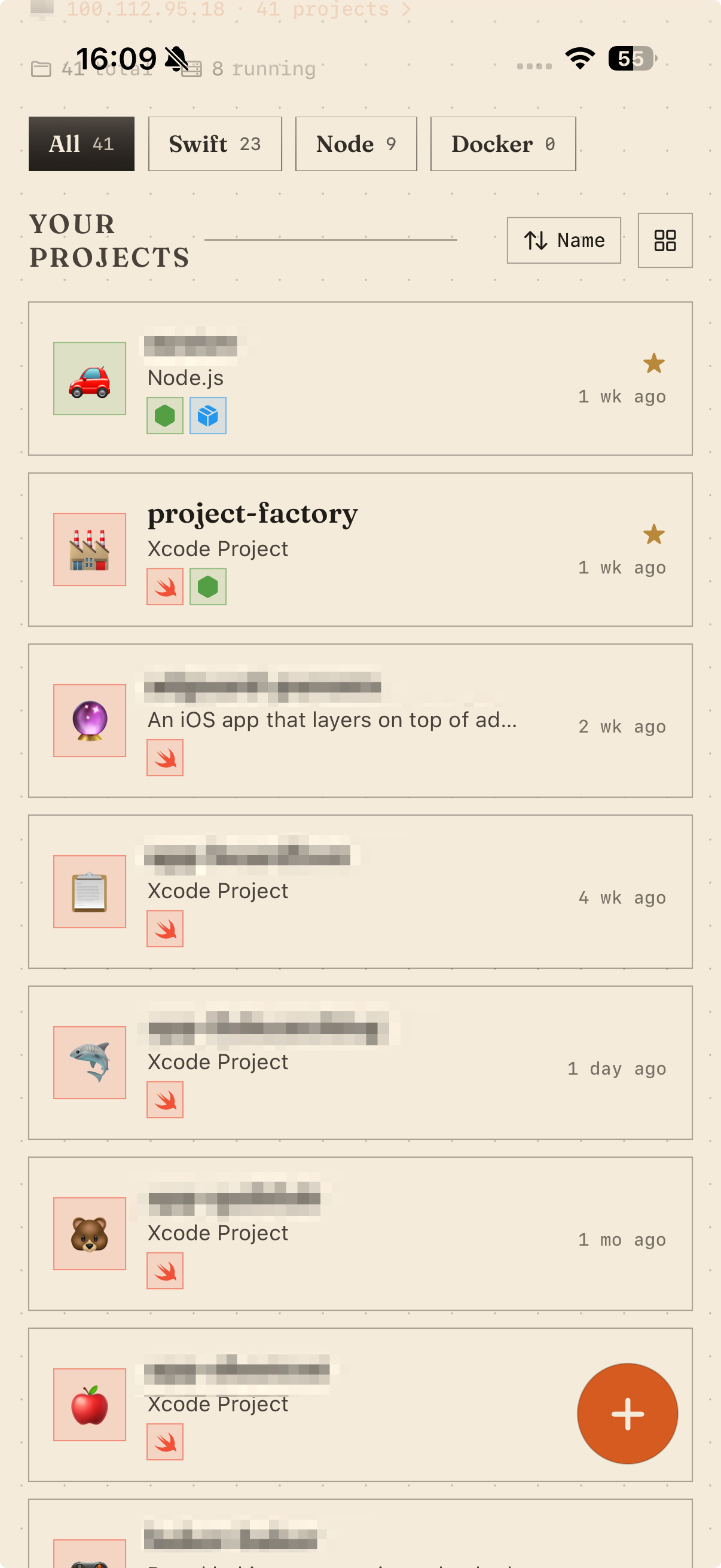
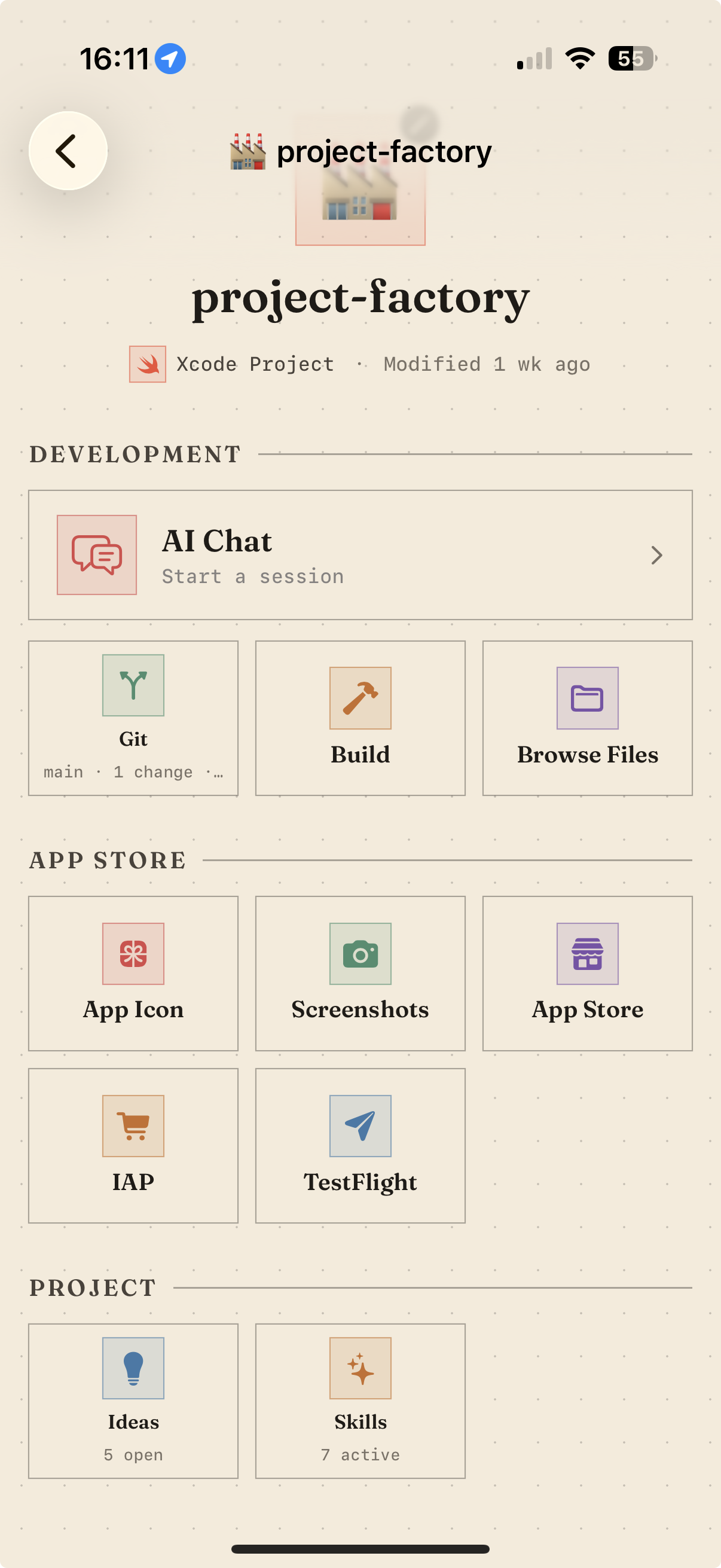
~/dev/ (left), and a single project's controls, from an AI Chat session to a TestFlight build (right).I’ve now got roughly 40 repos in my dev folder, around a dozen of them native iOS apps, and Project Factory itself is currently keeping tabs on them. After roughly 120 builds in XCode I’m sketching up new apps faster than I can think of names for them (which you can see is not my strong point anyway).
The visual impact of all this is just what this blog title suggests - since Opus 4.6 and Project factory, a mountain of possible software, that NEVER could have otherwise existed:
~/dev/, by first commit date. Flat near six for most of 2025, then roughly six times that within five months.The projects that would never have existed
The mountain of possible software is a whole category of tools that exists that simply wouldn’t have, because it could never justify the cost of building it.
When a project takes a whole weekend, you only build the ones with a plausible audience or a seriuos chance of being very useful. When it takes an afternoon, or a walk and a few voice notes, the maths changes completely. Audience of one is fine.
So my newly possible software includes:
Too niche to ever be a real product:
- A water-chemistry calculator iOS app for home brewing.
- An AI tone advisor for one specific guitar pedal.
- A planting calendar iOS app.
- A science-based tinnitus sound therapy iOS app.
- A Mac app that trims unneeded files from Time Machine backups.
Things I’d never dare try and make public:
- A World Cup lineup planner I built for my son - don’t fancy getting FIFA’s approval.
Too personal to be anyone else’s app:
- A personalised podcast generator that turns my news feeds into something I can listen to on a walk.
- A private health logger.
- A few home-automation agents wired up to my own house.
- A custom iOS keyboard tuned for how I talk to LLMs.
Few of these will ever see an App Store listing. Most of them shouldn’t. But they all get used, by me, and they all do something a generic tool didn’t quite do.
Bearing in mind before this year I have never touched a line of Swift or even wanted to build an iOS app, it’s incredible how wide the gates have opened in terms of not what can be built, but what should be built.
With Fable 5 released this week and already proving a powerful planning tool to hand off tasks to less advanced agents, the question is, what will you build next?